
Okt. 14, 2026
Events
Dieses Glossar erläutert einige Fachbegriffe sowie Gebrauchs- und Handelsnamen, die in diesem Katalog verwendet werden. Diese Begriffe werden im Kontext der Vakuumventiltechnik erklärt.
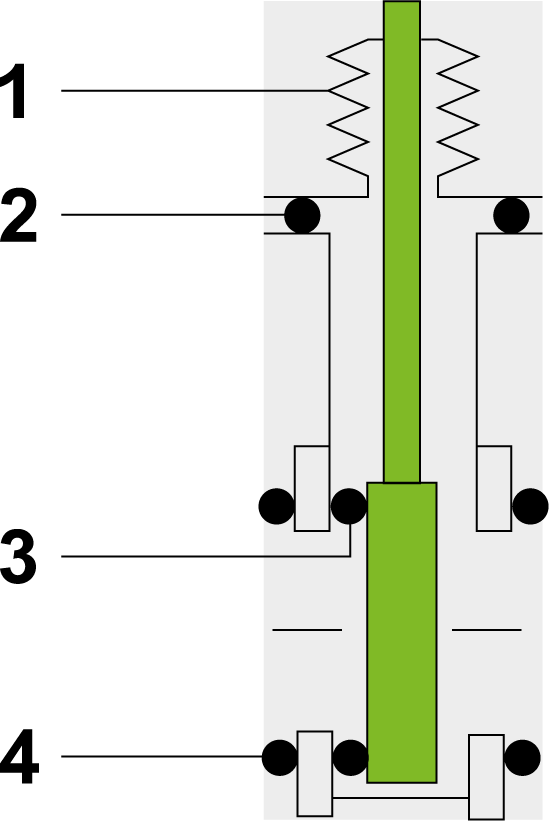
Einige Ventile verfügen zudem über eine Dichtung zwischen dem Gehäusedeckelflansch und der Antriebsbaugruppe. Diese Dichtung besteht aus dem gleichen Werkstoff wie die Kopfdichtung.
Ein Druckregler, der sich selbsttätig an Änderungen des Drucks, Gasflusses und Saugvermögens anpasst, ohne dass manuelle Einstellungen erforderlich sind. Dies ermöglicht einen vollständigen Automatikbetrieb des Systems.
Kurzform von «nicht ferromagnetisch». Die relative magnetische Permeabilität bzw. magnetische Leitfähigkeit μr wird mit einem Permeameter gemessen.
Die meisten VAT-Ventile sind optional in einer antimagnetischen Ausführung erhältlich. Wir unterscheiden zwischen zwei Klassen von antimagnetischen Ventilen:
Klasse 1:
Teile μr < 1.05
Schweissnähte μr < 1.08
Klasse 2:
Teile μr < 1.3
Schweissnähte μr < 1.3
Um diese geringen Werte zu erreichen, werden spezielle Werkstoffe verwendet. Bei Edelstahl wird der Herstellungsprozess sorgfältig überwacht. Kleine, leichte Teile können μr-Werte von über 2 aufweisen.
ASA-Flansche wurden ursprünglich für Hochdruckanwendungen entwickelt. Erst später wurden sie in der Vakuumtechnik eingesetzt. ASA-Flansche weisen einen grösseren Abstand zwischen den Montagebohrungen und dem Nenndurchmesser (DN) auf als andere Vakuumflansche.
ASA-LP-Flansche (LP = Large Port) sind ASA-Flansche mit einem grösseren Nenndurchmesser. Der Aussendurchmesser (OD) und die Montagebohrungen entsprechen denen eines ASA-Flansches. ASA-LP-Flansche sind für Nenndurchmesser von 2½" bis 12" erhältlich.
Beispiel:
ASA 6" hat einen Nenndurchmesser von 6".
ASA-LP 6" hat einen Nenndurchmesser von 8".
Zur Abdichtung der Antriebswelle werden Bälge verwendet. In VAT-Ventilen kommen ausschliesslich geformte und geschweisste Metallbälge zum Einsatz. Diese Dichttechnologie bietet folgende Vorteile:
Die Desorption physikalisch oder chemisch gebundener Gase von den Innenflächen eines Vakuumbehälters ist der letzte Schritt der Prozesse «Diffusion» und «Permeation».
Bei der Ventilherstellung wird eine geringe Desorptionsrate erreicht durch:
Der Differenzdruck ist die Druckdifferenz auf beiden Seiten des geschlossenen Ventilschiebers.
(siehe auch Ventilsitzseite, Öffnungsrichtung, Schliessrichtung).
Diffusion ist der Transport eines Werkstoffs durch einen anderen Werkstoff. Wasserstoff löst sich in Edelstahl. Er diffundiert zur Innenfläche und begrenzt das Vakuum bei der Desorption.
Durch Vakuumtempern (Wasserstoffarmglühen) kann in besonderen Fällen bei der Ventilherstellung ein Bereich entstehen, in dem der Wasserstoffgehalt geringer ist. Dadurch wird die Diffusion von Wasserstoff zur Innenfläche verringert, wodurch sich die Desorption ins Vakuum verringert.
Siehe Nenn-Innendurchmesser.
Eine Drehdurchführung ist ein Bauteil, das eine Dreh- oder Schwenkbewegung in das Ventilinnere überträgt. Die Drehdurchführungen von VAT sind mit Elastomer abgedichtet und mit einem Vakuumfett auf Fluorbasis geschmiert. Der Gasübertrag ins Ventilinnere ist wesentlich geringer als bei einer Wellendurchführung mit identischem Durchmesser.
Die Betriebskosten sind aufgrund der langen Lebensdauer und der geringen Kosten für Ersatzteile (keine Bälge) deutlich niedriger als bei einer Balgdurchführung.
Vakuumdrücke sind immer Absolutdrücke, es sei denn, sie werden ausdrücklich als Druckdifferenzen angegeben.
Druckwerte für Druckluft sind stets Druckdifferenzen zum Atmosphärendruck, z. B. Überdrücke.
Bleibende Verformung einer Elastomerdichtung nach der Druckentlastung. Der Druckverformungsrest (DVR) hängt von der Art des Werkstoffs ab und muss bei der Auslegung dynamischer Dichtungen berücksichtigt werden.
DVR = 100 · (ho – h2)/(ho – h1)
DVR … Druckverformungsrest (%)
ho … Ursprüngliche Höhe der Dichtung
h1 … Höhe der Dichtung im komprimierten Zustand
h2 … Höhe der Dichtung nach Druckentlastung
Die angegebenen Drücke der Druckluft sind stets Überdrücke in bar.
In einem Vakuumsystem, das gepumpt wird und in das gleichzeitig Gas eingelassen wird, kann der Druck auf zwei Arten geregelt werden:
Elastomere sind Werkstoffe mit gummiähnlichen Eigenschaften. Sie eignen sich sehr gut für Dichtungen (z. B. FKM).
Siehe «Perfluorelastomer».
Siehe «Fluoroelastomer».
Das FlapVAT-Transferventil wird für Öffnungshöhen bis zu 100 mm als kostengünstige Ergänzung zum SolVAT-Transferventil angeboten. Die verwendete Ventiltechnik wird als Klappenventil bezeichnet. Im Vergleich zu anderen Klappenventilen zeichnet sich das FlapVAT-Transferventil durch eine lange Lebensdauer der Dichtung aus und ist in der geschlossenen Stellung mechanisch verriegelt. Optional ist es auch in der Ausführung «in beide Richtungen differenzdruckbeständig» erhältlich.
Funktion:
Eine Welle, an der ein Mechanismus angebracht ist, wird durch einen pneumatischen Antrieb gedreht. Je nach Drehrichtung der Welle wird der Mechanismus mit dem Ventilschieber entweder in die geöffnete oder in die geschlossene Stellung bewegt.
Dieses dynamische, vollständig aus Metall gefertigte Dichtsystem zeichnet sich durch gleichbleibende Dicht- und Schliesskräfte aus. Dadurch lassen sich hohe Dichtkräfte bei vergleichsweise geringen Axialkräften erzielen. Die Dichtpartner bestehen aus Edelstahl und werden lediglich elastisch verformt. Das FLEX VATRING-System eignet sich für den Einsatz in extremen UHV-Anwendungen. Es kann bei 300 °C in offener wie auch in geschlossener Stellung ausgeheizt werden und erreicht beim Betrieb unter reinen Bedingungen eine Lebensdauer von > 1 000 Zyklen.
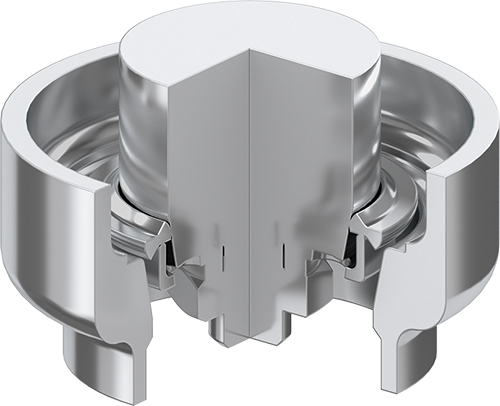
Fluorelastomer (FKM oder FPM) hat eine hohe chemische Beständigkeit. Fluorelastomere verschiedener Hersteller weisen hinsichtlich ihrer chemischen Beständigkeit, Temperaturbeständigkeit, mechanischen Eigenschaften und Reinheitsstufe etwas unterschiedliche Eigenschaften auf.
Abkürzung für «Flat Panel Display». Bezeichnet Flachbildschirme, die beispielsweise in Fernsehgeräten oder Computern zum Einsatz kommen.
Die statischen Dichtungen und die Sitzdichtung bestehen aus Metall. Da diese Ventile schmiermittelfrei sind und keine Elastomere oder Plastomere enthalten, ist ihre Gasabgaberate sehr gering. Sie können bei höheren Temperaturen ausgeheizt werden. Daher werden sie für extreme UHV-Anwendungen verwendet. Dank eines speziellen Antriebs sind sie selbst bei höheren Werten (108 Gy) strahlungsbeständiger als Ventile mit Elastomerdichtung.
Die Gasabgaberate (in mbar Is-1) ist die Summe aller Gasbelastungen, die verursacht werden durch:
Eine geringe Gasabgaberate ist für ein effizientes Abpumpen und einen niedrigen Basisdruck unerlässlich. Bei der Ventilherstellung wird eine geringe Gasabgaberate erreicht durch:
Zusätzlicher Gasstrom direkt in das Ventil. Ein geringer Überdruck verringert das Eindringen von Gas in das Ventilinnere erheblich, wodurch der Ventilmechanismus und die Dichtung vor Verunreinigungen geschützt werden.
Die Gasspülung ist nur in Verbindung mit Schutzringen sinnvoll. Der Schutzring minimiert das Eidnringen von zusätzlichem Gas und die Auswirkungen auf den Prozess. Die Art des Gases und die Durchflussmenge hängen vom jeweiligen Prozess ab. In der Regel beträgt die Gasspülmenge zirka 5 % des Prozessgasflusses.
Ventile der Serie 17 sind mit einem Anschluss für die Gasspülung erhältlich.
Bereich mit (lokal) erhöhter Strahlenbelastung und erhöhter Temperatur. Die Strahlenbelastung ist höher, als normalerweise verwendete Werkstoffe während der voraussichtlichen Nutzungsdauer standhalten können.
Ventile sind in der Regel je nach den verwendeten Dichtwerkstoffen im Bereich von 103 bis 106 Gy strahlungsbeständig. Antriebe sind normalerweise für 101 bis 105 Gy ausgelegt.
Für höhere Strahlungswerte sind nur Ganzmetallventile mit einem speziellen Antrieb geeignet.
Bestandteile:
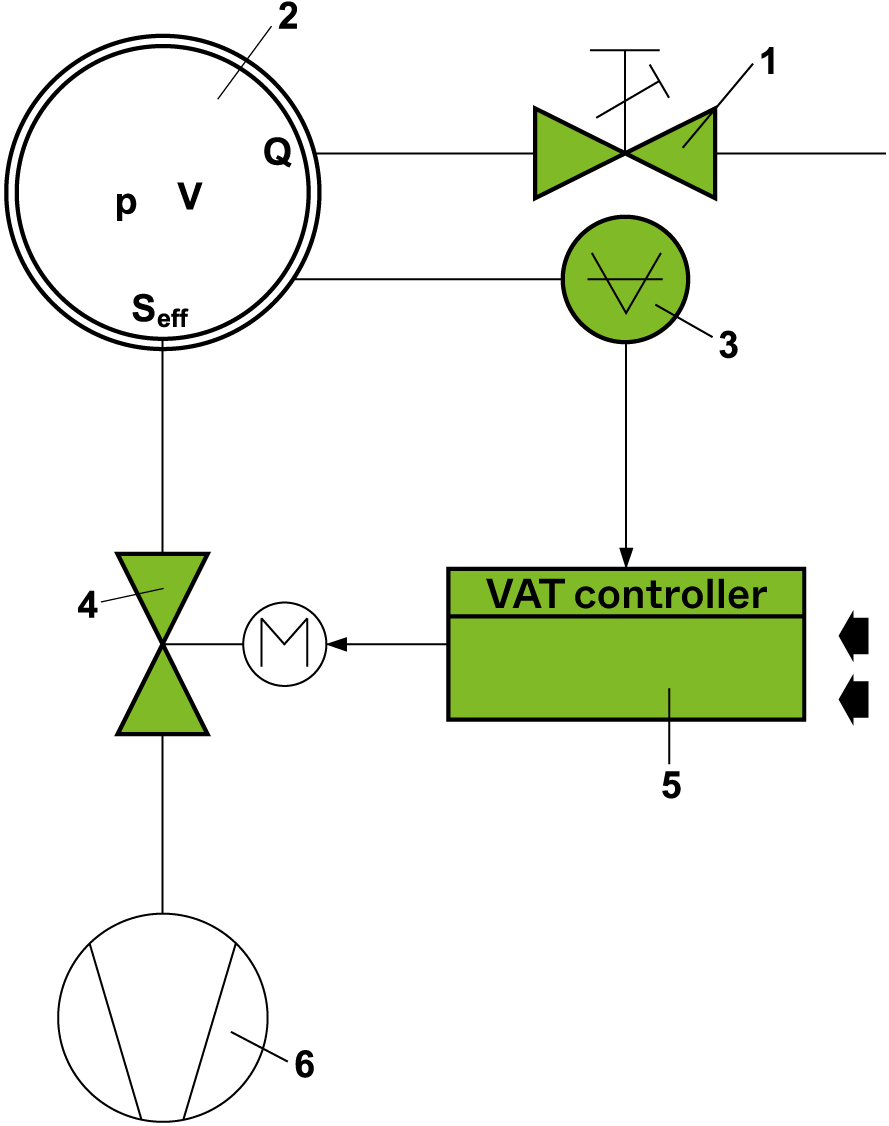
Im stationären Zustand gilt folgende Formel:
Seff … Q/p
Seff … Effektives Saugvermögen (ls-1)
Q … Gasfluss (mbar·ls-1)
p … Druck (mbar)
oder für die in den USA verwendeten Einheiten
Seff = 12.7 × Q/p
Seff … Effektives Saugvermögen (ls-1)
Q … Gasfluss (sccm)
p … Druck (mTorr)
Funktionsprinzip:
Der Druckregler gleicht den vom Drucksensor gemessenen Ist-Druck in der Prozesskammer mit dem voreingestellten Druck ab. Aus der Differenz zwischen Ist- und Soll-Druck errechnet der Druckregler die korrekte Stellung des Regelventils. Der Druckregler bringt das Regelventil in die richtige Stellung und der Ist-Druck entspricht wieder dem eingestellten Druck.
Dieser Vorgang wird kontinuierlich durchgeführt. Druckänderungen in der Prozesskammer aufgrund von Lecks, Desorption, Gasfluss, Reaktionsprodukten, Schwankungen des Saugvermögens usw. werden immer umgehend korrigiert.
Einheit für die Energiedosis im SI-System (internationales Einheitensystem). Die Energiedosis ist die vom Werkstoff pro Masseneinheit absorbierte Strahlungsenergie.
1 Gy = 1 J/kg = 100 rad
Dies gewährleistet einen geringen HF-Widerstand bei geöffnetem Ventil. In der geöffneten Ventilstellung wird ein Metallring, der die geometrische Form des Strahlrohrs aufweist, zwischen den beiden Anschlussflanschen gespreizt und sorgt für eine direkte elektrisch leitende Verbindung zwischen den beiden Flanschen.
«Hohe Reinheit» ist ein Sammelbegriff für Sauberkeitsanforderungen, die den höchsten Kundenanforderungen in Bezug auf Partikel sowie auf organische und anorganische Substanzen entsprechen. Hochreine Prozesse decken den gesamten Herstellungsprozess ab – von der Fertigung und Reinigung einzelner Teile bis hin zur Montage und Verpackung der Produkte.
Die meisten pneumatisch betätigten VAT-Ventile können optional mit einem Impulselektromagnet ausgestattet werden. Zur Betätigung benötigt das Ventil lediglich einen kurzen elektrischen Impuls von > 50 ms. Zwischen den Betätigungsvorgängen ist der Elektromagnet stromlos; er kann aber auch unter Spannung stehen. So ist sichergestellt, dass sich die Ventilstellung bei einem Stromausfall nicht ändert.
Von VAT entwickeltes Dichtsystem mit Keildesign für die Schieberventile der Serie 09.
Dieses äusserst robuste System ist mit einem keilförmigen Schieber ausgestattet, der auf einen entsprechenden Sitz im Gehäuse gedrückt wird. Die Kompression des O-Rings wird durch PEEK-Gleitelemente begrenzt. Dadurch lässt sich eine gute Leckrate mit einer entsprechenden Lebensdauer kombinieren, selbst bei wiederholten Differenzdruckbelastungen von bis zu 1 bar. Zudem verhindern die Gleitelemente einen dynamischen Kontakt von Metall auf Metall und vermeiden dadurch die Partikelbildung. Dies kann bei empfindlichen Anwendungen von entscheidender Bedeutung sein.
DeviceNet: DeviceNet® ist ein digitales Netzwerk, das als Kommunikationsnetzwerk zwischen industriellen Steuerungen und E/A-Geräten dient. Es basiert auf dem CAN-Standard (Controller Area Network) und wurde ursprünglich von Allen Bradley entwickelt. Heute wird es von der gemeinnützigen Organisation DeviceNet Vendors Association (ODVA) betreut.
CC-Link: CC-Link (Control and Communications Link) ist ein Zusammenschluss offener industrieller Netzwerke, die zur Übertragung von Steuerungsdaten und Informationen dienen. Der Standard ist in Asien weit verbreitet. Es wurde ursprünglich von der Mitsubishi Electric Corporation als internes Netzwerk entwickelt. Aufgrund der steigenden Nachfrage wurde es schliesslich als offenes Netzwerk freigegeben.
EtherCAT: EtherCAT (Ethernet for Control Automation Technology) ist ein Ethernet-basierter Feldbus, der von Beckoff Automation entwickelt wurde. Das Hauptziel der EtherCAT-Entwicklung bestand darin, kurze Zykluszeiten und eine geringe Jitter-Rate (Laufzeitabweichung) zu erreichen. Diese Schnittstelle eignet sich deshalb für Automatisierungsanwendungen, die kurze Update-Zeiten der Daten erfordern.
Ethernet: Ethernet ist eine Familie von Technologien für Computernetzwerke, die üblicherweise zur Verbindung von lokalen Netzwerken (Local Network, LAN) sowie von grösseren Netzwerken wie Wide Area Networks (WAN) eingesetzt wird. Diese Technologie dient zum Datenaustausch zwischen Geräten, die über das Netzwerk verbunden sind, und basiert auf vordefinierten Datenframes.
Logic: Logic ist eine einfache Kommunikationsschnittstelle, über die Benutzer mithilfe einfacher digitaler und analoger Signale mit einem Gerät kommunizieren können. Die in VAT-Controllern verwendete Logic-Schnittstelle unterstützt mehrere digitale und analoge Eingänge zur Steuerung des angeschlossenen Geräts. Zusätzliche digitale und analoge Ausgänge können für Statusabfragen genutzt werden. Jeder Ein- und Ausgang hat seine eigene festgelegte Funktion.
Profibus: Profibus (Process Field Bus) ist ein internationaler Feldbusstandard, der zur Kommunikation im Bereich der Automatisierungstechnik eingesetzt wird. Der Standard wurde von 21 Unternehmen entwickelt und vom Bundesforschungsministerium (ehemals BMBF, inzwischen BMFTR) in Deutschland gefördert. Profibus eignet sich für zeitkritische Anwendungen wie auch für komplexe Kommunikationsaufgaben.
RS232: RS232 ist ein weit verbreiteter Standard für die serielle Datenübertragung. Er wurde Anfang der 1960er Jahre von der EIA (Electronic Industries Association) entwickelt. RS232-Schnittstellen werden in Industrieanlagen nach wie vor häufig verwendet, da sie leicht zu implementieren sind und für einfache Aufgaben vollkommen ausreichen.
RS485: Die RS485-Schnittstelle, auch bekannt als EIA-485, ist ein Industriestandard, der in seriellen Kommunikationssystemen zum Einsatz kommt. Durch die Verwendung symmetrischer Differenzleitungen für die Datenübertragung lassen sich Störeinflüsse verringern, wodurch höhere Taktfrequenzen und längere Übertragungswege möglich sind. Die RS485-Schnittstelle wird im Bereich der industriellen Automatisierung nach wie vor oft verwendet.
Anzahl der Zyklen (Öffnen-Schliessen-Öffnen), bei denen ein Ventil unter reinen Bedingungen und bei normalen Temperaturen ohne jegliche Wartung sicher betrieben werden kann.
Heliumgas strömt mit einem Druck in mbar ls-1 durch eine Dichtungsanordnung oder ein Gehäuse. Während der Messung liegt die Differenz des Helium-Partialdrucks in der Grössenordnung von 1 000 mbar. Der Anstieg des Heliumgasflusses während der Prüfdauer (in der Regel 1 Minute) entspricht der Leckrate. Die Prüfdauer hängt von der Heliumpermeationsrate durch die Dichtung und der Vakuumzeitkonstante des Systems ab.
Der Gasfluss durch ein Bauteil (Ventil, Rohr, Membran) hängt vom Differenzdruck am Bauteil ab. Der Proportionalitätsfaktor ist der Leitwert.
q = L · Δp (mbar ls-1)
q … Gasfluss (mbar ls-1)
L … Leitwert (ls-1)
Δp … Druckdifferenz (mbar)
Im Hochvakuum gibt es eine Molekularströmung. In diesem Fall hängt der Leitwert ausschliesslich von der Bauteilgrösse ab.
Der Innendurchmesser eines offenen VAT-Ventils ist an jeder Stelle gleich gross oder grösser als der entsprechende Rohrdurchmesser. Der Leitwert eines VAT-Ventils entspricht somit in etwa der eines Rohrs mit identischer Konfiguration, identischem Durchmesser und identischer Länge.
Der im Katalog angegebene Leitwert für die Molekularströmung wird anhand der Formel für lange Schläuche berechnet. Dies gilt für Ventile, die in einem Rohr mit identischem Durchmesser eingebaut sind.
Formel für Schieberventile: Lv = 12.2 × D3/l
Formel für Eckventile: Lv = 12.2 × D3/(2 × e + 0.7 × D)
Näherungsformel für rechteckige Ventile:
Lv = 40 × a2 × b2/((a+b) × l)
a … Schlitzlänge (cm)
b … Schlitzbreite (cm)
D … Innendurchmesser des Ventils (cm)
e … Abstand zwischen den Eckflanschen (cm)
(Mass A im Massbild)
(0.7 D ist der Korrekturfaktor für eine 90°-Biegung.)
I … Länge Flansch-zu-Flansch des Ventils (cm)
Lv … Leitwert für die Molekularströmung (ls-1)
Der Leitwert L eines Rohres setzt sich aus dem Leitwert der Öffnung (Blende) LB und dem Leitwert der Rohrelemente LRi zusammen.
1/L = 1/LB+ Σi 1/LRi
LB … 9.2 × D2
LR … 12.2 × D3/I (Formel für lange Rohre)
D … Innendurchmesser (cm)
I … Länge eines Rohrelements (cm)
L, LB, LR … Leitwert (ls-1)
Die Formel für kurze Rohre enthält die Leitwerte der Blende und des Rohrs. Dies gilt in der Regel nicht für Ventile.
Formel für das effektive Saugvermögen einer Pumpe:
1/Seff = 1/So + Σi 1/LRii
So … Nennsaugvermögen (ls-1)
LRi … Leitwerte von Schläuchen und Ventilen (ls-1)
So wird an der Blende berücksichtigt. Alle Leitwerte von Schläuchen und Ventilen müssen mit der Formel für lange Schläuche berechnet werden.
Die L-Motion-Technologie steht für eine mechanisch ausgelöste L-Bewegung des Schiebers in Kombination mit einem patentierten Schieber-/Wellenanschluss. Dies ermöglicht ein gleichmässiges Anpressen der Dichtung.
Speziell für anspruchsvolle Anwendungen in Halbleiterproduktionsprozessen entwickelt. Dieses Transferventil mit L-VAT ist mit vulkanisierten oder O-Ring-Schieberdichtungen ausgestattet. Die L-Bewegung erfolgt mechanisch. Die L-VAT-Technologie verfügt über einen äusserst zuverlässigen Einwellenantrieb sowie eine balggedichtete Durchführung und ermöglicht eine schnelle und einfache Wartung.
Es werden ausschliesslich metallische Werkstoffe verwendet, die den geltenden internationalen Qualitätsnormen entsprechen. Für Stahl gelten die Anforderungen der Norm EN 10088 bzw. die entsprechenden ASTM-Vorschriften. Bei Aluminium werden die Normen EN 485 und EN 573 eingehalten. Für alle anderen metallischen Werkstoffe gelten entsprechende Vorschrfiten und Normen analog.
Von VAT entwickelte und patentierte Dichtungskonfiguration für mit Elastomer abgedichtete Schieber- und Transferventile. Sie zeichnet sich durch eine stossfreie und nahezu partikelfreie Betätigung sowie eine sehr lange Lebensdauer aus.
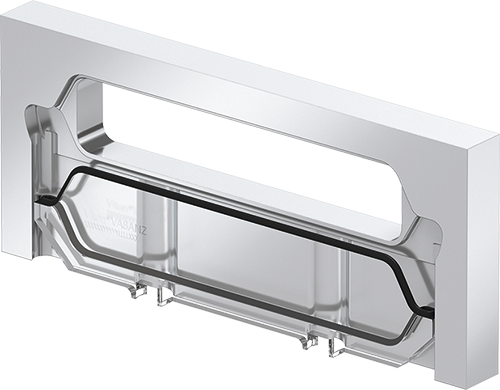
Grössenbezeichnung eines Flansches. Der Nenn-Innendurchmesser (DN) entspricht nicht immer dem kleinsten Durchmesser eines Flanschs oder Rohrs.
Abkürzung für Nitril-Butadien-Kautschuk (NBR). Es handelt sich um einen Elastomerwerkstoff für Dichtungen.
O-Ring-Dichtungen bestehen aus Werkstoffen mit gummiähnlichen Eigenschaften. Sie werden in Nuten eingesetzt. Durch den Druck wird der O-Ring in die Nut gedrückt. zwischen der Dichtungsnut und dem O-Ring bleiben kleine Hohlräume.
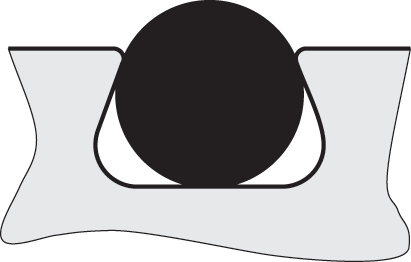
Siehe auch «vulkanisierte Dichtung».
Als Öffnungsrichtung wird die Richtung bezeichnet, in die der Schieber beim Öffnen des Ventilsitzes eingefahren wird.
Partikel in Ventilen entstehen hauptsächlich durch die Reibung der Ventilkomponenten. VAT entwickelt und setzt eine Vielzahl von Inspektionsgeräten zum Nachweis von Partikeln ein. Die Inspektionen finden im eigenen VAT-Labor statt. Dadurch lassen sich fundierte Erkenntnisse über die Partikelemission unserer Ventile gewinnen; die Qualität der Ventilkomponenten lässt sich entsprechend verbessern.
Je nach Anwendungsbereich der Ventile werden Partikelemissionen entweder mit optischen Nachweisgeräten (Partikel > 300 nm) oder mithilfe eines Differential-Mobilitätsanalysators (Partikel > 10 nm) erfasst.
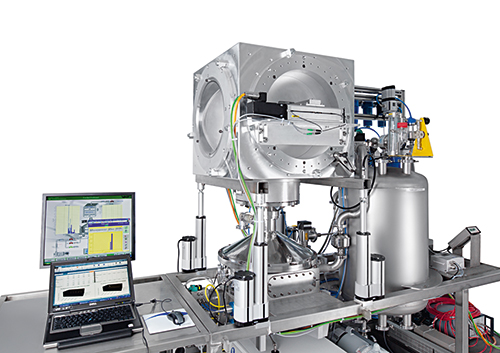
VAT-Partikelprüfstand für Partikel > 10 nm
Abkürzung für Polyetheretherketon (hochtemperaturbeständiger Thermoplast).
Perfluor (FFKM oder FFPM) ist ein vollständig fluoriertes, wasserstofffreies FKM. Die chemische Beständigkeit ist höher als die von FKM.
Die Permeation ist ein mehrstufiger Prozess. Das an der Aussenwand adsorbierte Gas löst sich im Werkstoff, diffundiert durch den Werkstoff und desorbiert an der Innenwand. Bei Edelstahl können Gasströme aufgrund von Permeation bei den in der Vakuumtechnik üblichen Temperaturen vernachlässigt werden. Diese Gasströme müssen jedoch bei Elastomer- und Plastomer-Dichtungen berücksichtigt werden.
Für FKM weisen die Permeationsraten P nach längerer Lagerung bei Raumtemperatur in etwa folgende Werte auf:
He P = 10 × 10-8 cm2 s-1
O2 P = 1 × 10⁻⁸ cm2 s-1
N2 P = 0,6 × 10⁻⁸ cm2 s-1
Für ein Gehäuse mit der Fläche A (cm²) und der mittleren Diffusionslänge I (cm) beträgt der durch Permeation verursachte Gasstrom Q bei einer Druckdifferenz Δp (mbar) etwa:
Q = P × A/I × Δp (mbar ls-1)
Für Luft bei Atmosphärendruck betragen die Partialdrücke p der jeweiligen Gase:
He p = 5.0 × 10⁻³ mbar
O2 p = 2.1 × 10² mbar
N2 p = 7.8 × 10² mbar
Bei gut entgasten O-Ringen ist die Permeation von Stickstoff und Sauerstoff aus der Luft durch das FKM der Hauptgrund für die Gasabgabe.
Der durch Permeation verursachte Heliumgasfluss kann je nach Dichtung nach einer gewissen Zeit während der Dichtheitsprüfung zu einer erheblichen Undichtigkeit führen.
Es gibt drei Arten von Teflon®: PTFE, FEP und PFA. In diesem Katalog wird der Begriff «Teflon®» ausschliesslich für den Typ PTFE verwendet.
Hohe chemische Beständigkeit (vergleichbar mit PTFE), jedoch höhere mechanische Festigkeit und Härte. PFA wird für chemisch äusserst beständige Dichtungen verwendet.
Bezeichnung für Werkstoffe, die vorwiegend für plastisch verformbare Dichtungen verwendet werden (z. B. PFA, Tenic®).
VAT-Ventile sind mit verschiedenen Arten von Pressluftzylindern und verschiedenen Elektromagnet-Ventilen erhältlich. Selbst bei Ventilen ohne mechanische Verriegelung lässt sich die Ventilstellung bei einem Druckluftausfall für einen bestimmten Zeitraum aufrechterhalten, indem am Drucklufteinlass ein Rückschlagventil eingebaut wird.
Abkürzung für Polyoxymethylen (ein thermoplastischer Werkstoff).
Abkürzung für Photovoltaik. Bezeichnet die Technologie zur Umwandlung von Sonnenlicht in elektrische Energie.
Das hohe Qualitätsniveau der VAT-Ventile wird im Rahmen des TQM-Systems (Total Quality Management) geplant und während der Fertigung und Montage kontinuierlich überwacht. Die Überwachung erfolgt mittels statistischer Prozesssteuerung (Statistical Process Control, SPC) in Kombination mit modernen Messgeräten, z. B. 3D-Koordinatenmessgeräten und automatisierten Ventilprüfgeräten mit automatischer Datenerfassung.
An jedem VAT-Ventil werden folgende Prüfungen durchgeführt:
Teile / Unterbaugruppen:
Komplettes Ventil:
Auf Kundenwunsch können zusätzliche Prüfungen durchgeführt und Konformitätsbescheinigungen, Abnahmeprüfungsprotokolle, Prüfbescheinigungen sowie Werkstoffzertifikate ausgestellt werden.
Als Schliessrichtung wird die Richtung bezeichnet, in der sich der Schieber beim Schliessen dem Ventilsitz nähert.
Die Zeit zwischen dem Schalten der Elektromagnetspannung und dem Erreichen der vollständig geschlossenen, vakuumdichten bzw. offenen Position des Schiebers.
Die Angaben im Katalog geben gängige Werte wieder. Sie hängen vom Druck der Druckluft, der Einbaulage des Ventils, den Querschnitten und Längen der Druckluftleitungen sowie von der Messmethode und vom Messsystem ab.
Bei Schnellschlussventilen wird der Begriff «Gesamtschliesszeit» verwendet. Damit gemeint ist die Zeit zwischen Auslösen des Sensors (ohne Reaktionszeit des Sensors) und Erreichen der vollständigen Geschlossen-Stellung des Schiebers.
Als Schmiermittel im Vakuumbereich wird ein Vakuumfett auf Fluorbasis verwendet. Festschmiermittel und Metallfilme werden normalerweise nicht als Schmiermittel bezeichnet.
«Schmiermittelfrei» bzw. «trocken» bedeutet, dass Reibungsprobleme im Vakuum so gelöst werden, dass keine Kohlenwasserstoff- oder Silikondämpfe in das Vakuum gelangen.
Der Schrittmotor eignet sich gut für die exakte Positionierung des Ventiltellers. Daher wird er oft als Antrieb für Regelventile eingesetzt.
Bei einem offenen Schieberventil überbrückt der Schutzring die Öffnung zwischen den Flanschen. Für den Gasstrom wirkt das geöffnete Ventil wie ein Rohr, d. h., es weist keine Veränderungen im Innendurchmesser auf.
Der Schutzring verbessert den Gasfluss, verringert die Verschmutzung des Ventilinneren und schützt die Schieberdichtung vor Wärmestrahlung (z. B. wenn das Schieberventil als Absperrvorrichtung für heisse Medien eingesetzt wird). Eine zusätzliche Gasspülung trägt dazu bei, das Innere des Ventils vollständig zu schützen.
Ein Ventil kann anstelle eines Flansches mit einem Schweissstutzen ausgestattet sein. Ein solches Ventil kann direkt in ein Rohr geschweisst werden oder der Kunde kann einen entsprechenden Flansch anbringen. Es ist darauf zu achten, dass das Ventil nicht verformt oder verunreinigt wird.
Kurzform für symmetrisches Durchflussventil. Ventilkonzept, bei dem der Prozessgasstrom bei der Druckregelung symmetrisch um den Schieber verläuft.
Ein Shutter reduziert den vollen Leitwert innerhalb kürzester Zeit auf ein geringes Leck (nicht vakuumdicht). Dadurch wird verhindert, dass sich die Druckwelle eines Lufteinbruchs ausbreitet. Shutter sind mit Ganzmetallventilen kompatibel.
Im Zusammenhang mit Dichtungen eine Kurzform für Silikonkautschuk.
Ein Ventil, das in erster Linie für die Solarmodulproduktion entwickelt wurde und über ein spezielles, von VAT entwickeltes Verriegelungssystem verfügt. Der dichte Verschluss wird durch einen Schieber gewährleistet, der mit einer O-Ring-Dichtung versehen ist. Das SolVAT-Ventil basiert auf einem modularen Aufbau. Die Anpassung an die erforderliche Substratgrösse ist daher unkompliziert. Das Ventil ist äusserst widerstandsfähig gegenüber aggressiven Medien und hohen Temperaturen und ist in einer Vielzahl von Werkstoffen und Werkstoffkombinationen erhältlich.
Durch den Einsatz spezieller Werkstoffe wird die Lebensdauer unter ionisierender Strahlung gegenüber herkömmlichen Ventilen erhöht. Die Strahlungsbeständigkeit in Gray ist die Dosis, bis zu der das Ventil zuverlässig funktioniert (1 Gray = 100 rad).
Teflon® (PTFE), gefüllt mit Nickelpulver. Dichtwerkstoff für die chemische Industrie.
Verbindungstechnik für hohlraumfreie Verbindungen.
Darüber hinaus ist das Vakuumlöten ein ideales Verfahren zur Reinigung und Entgasung gelöteter Teile.
Für Ventile mit Schmiermitteln verwendet VAT ein Vakuumfett auf Fluorbasis mit sehr geringem Dampfdruck (< 5 x 10-13 mbar bei 20 °C).
Von VAT entwickelter Schieberventilmechanismus (z. B. bei den Serien 10, 11, 12, 14).
Schieberventile mit VATLOCK-System sind in der geschlossenen Stellung mechanisch verriegelt.
In der geöffneten Stellung ist der Mechanismus nicht verriegelt. Blattfedern halten den Schieber und die Gegenplatte zusammen mit den Kugelhaltern am Schlitten fest. Die Kugelpaare befinden sich in den Restungen.
Zum Schliessen wird der Mechanismus nach vorne in die Schliessposition bewegt.
Die Verriegelung beginnt, sobald der Anschlag der Blattfeder das Gehäuse berührt. Die Kugelhalter schieben die Kugelpaare aus den Rastungen heraus. Der Schieber und die Gegenplatte werden auseinandergezogen. Die Schieberdichtung wird ohne Abrieb gegen die Dichtfläche gedrückt. Die Anordnung der Kugelpaare sorgt dafür, dass die Dichtkraft zunimmt, wenn auf beiden Seiten des Schiebers ein Vakuum herrscht.
Beim Öffnen erfolgen die Schritte in umgekehrter Reihenfolge.
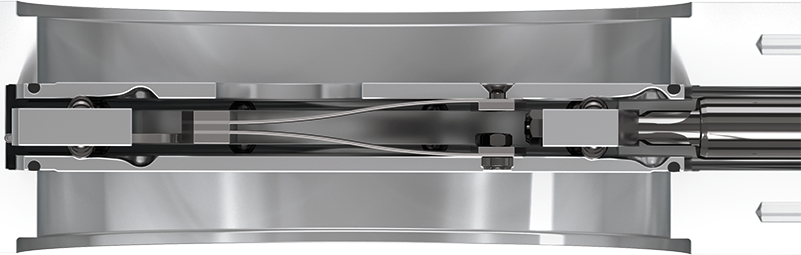
Dieses dynamische, vollständig aus Metall gefertigte Dichtsystem zeichnet sich durch gleichbleibende Dicht- und Schliesskräfte aus. Dadurch lassen sich hohe Dichtkräfte bei vergleichsweise geringen Schliess- bzw. Axialkräften erzielen. Die Dichtpartner bestehen aus Edelstahl und werden lediglich elastisch verformt. Das VATRING-System eignet sich für den Einsatz in extremen UHV-Anwendungen. Es kann bei 450 °C in geöffneter und bei 350 °C in geschlossener Stellung ausgeheizt werden und erreicht unter reinen Betriebsbedingungen eine Lebensdauer von > 100 000 Zyklen.
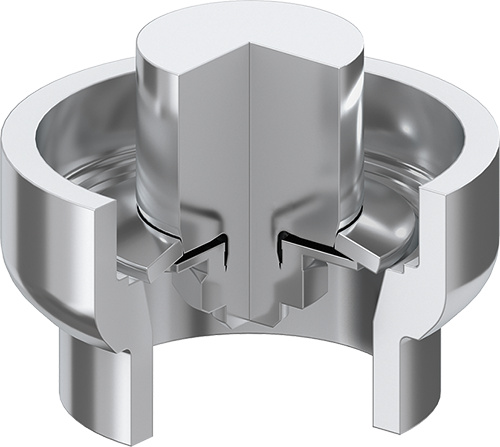
Diese von VAT entwickelte und patentierte Metallflanschdichtung erfordert lediglich parallele Flansche mit sorgfältig vorbereiteten, ebenen Dichtflächen.
VATTERFLY-Ventile können auf den ersten Blick leicht mit Klappenventilen verwechselt werden. Es handelt sich um schwenkbare Klappenventile, die in vielen Fällen eine kompakte und wirtschaftliche Alternative zu Schieberventilen darstellen. Bei VATTERFLY-Ventilen schwingt der Schieber zunächst in die geschlossene Stellung, ohne dass die Schieberdichtung Reibung ausübt. Für einen vakuumdichten Verschluss und eine sichere Verriegelung lässt sich der Teller schwenken. Die Abdichtung ist vergleichbar mit dem Verfahren bei einem Schieberventil.
VATTERFLY-Ventile der Serien 20.3/20.4 verfügen über eine Drehdurchführung.
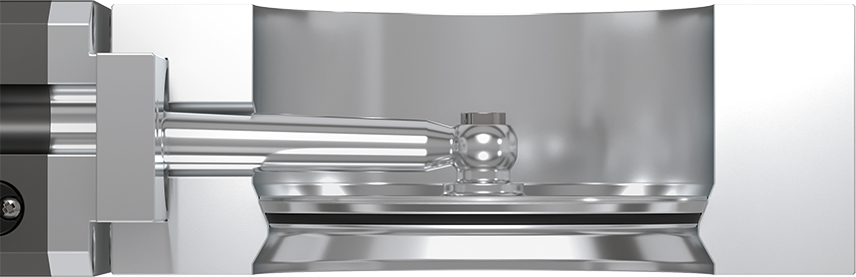
Ein Ventilnetzwerk, bestehend aus einem Hauptventil und einem oder mehreren Nebenventilen. Das Hauptventil wird vom Host-System gesteuert, während die Nebenventile dem Hauptventil folgen.
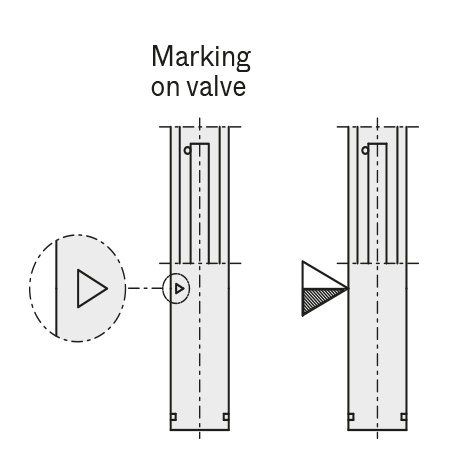
Seite mit der Schieberdichtung, die in den Massbildern mit  a gekennzeichnet ist. Jedes VAT-Ventil weist ein Dreieck
  auf, das in den Flansch auf der Sitzseite eingeprägt ist. Die Spitze des Dreiecks zeigt in Richtung Sitz. Diese Information ist im Zusammenhang mit dem Differenzdruck von Bedeutung (siehe Differenzdruck).
Ein Ventilmechanismus ist mechanisch verriegelt, wenn die Dichtkraft auch bei einem Ausfall der Schliesskraft erhalten bleibt. Dies wird normalerweise dadurch erreicht, dass ein Gelenk über den Mittelpunkt hinausbewegt wird.
Wird als dynamische Dichtung für UHV-Ventile und MONOVAT-Systeme verwendet (z. B. für die Serien 01, 02, 03, 04, 05, 10.8, 15, 20).
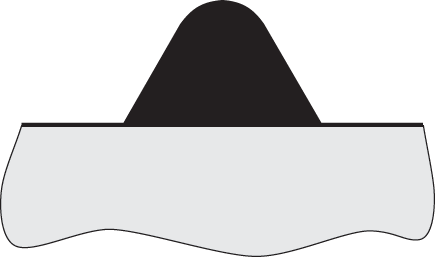
Die vulkanisierte Dichtung bietet gegenüber einer O-Ring-Dichtung folgende Vorteile:
Vulkanisierte Dichtungen können aus Fluorelastomer, Perfluorelastomeren, Silikonen oder EPDM hergestellt werden. Die Gasabgaberate, die Permeation und die Ausheizbarkeit entsprechen denen ausgewählter hochwertiger O-Ringe.
Eine Wellendurchführung besteht aus einem O-Ring und einer Spindel und überträgt eine lineare Bewegung in das Innere des Ventils. Die Elastomerdichtung ist mit einem Hochvakuumfett auf Fluorbasis geschmiert.
Beim Schliessen kann es im Ventilkörper zu einem kurzzeitigen Druckanstieg kommen.
In der geöffneten Position befindet sich ein Rohr zwischen den Flanschen. Zwischen den Enden des Rohres und den Flanschen verbleibt nur ein kleiner Spalt. Der HF-Widerstand des geöffneten Ventils wird dadurch erheblich verringert.
Transferventil mit L-Bewegung mit O-Ring als Schieberdichtung, das in erster Linie für die Produktion von Flachbildschirmen entwickelt wurde. Das XL-VAT-Ventil basiert auf einem modularen Aufbau. Die Anpassung an die erforderliche Substratgrösse ist daher unkompliziert. Der erforderliche Verriegelungsdruck kann über die Steuereinheit geregelt werden. Eine Überbeanspruchung des O-Rings am Ventil kann somit verhindert werden. Darüber hinaus ist das XL-VAT-Ventil so konzipiert, dass es sich sehr leicht warten lässt.
Um die Leckrate statischer Dichtungen zu verringern, können Dreh- und Wellendurchführungen doppelt abgedichtet werden, um den Raum zwischen den beiden Dichtungen zu evakuieren. Dieser Zwischenraum wird in der Regel auf einen Druck von 0.1 bis 10 mbar evakuiert. Der geringere Differenzdruck verringert die Permeation durch die Dichtung und den Gasfluss während der Betätigung.
Anzahl der Zyklen (Öffnen-Schliessen-Öffnen), die ein Ventil unter reinen Bedingungen ohne jegliche Wartung sicher betrieben werden kann. Nach der Durchführung der erforderlichen Wartungsarbeiten kann das Ventil wieder für die angegebene Anzahl von Zyklen verwendet werden. Durch den Betrieb verursachte Verschmutzungen und erhöhte Temperaturen können die Zeit zwischen den Wartungsintervallen verkürzen.
Eine Bewegung des Ventils bestehend aus Öffnen, Schliessen und Öffnen.